
Penistone Church FC
One Club. One Community





Penistone - The Cradle of the Modern Game of Assciation Football

1648
Football was already part of life in Penistone as far back as the mid-17th century. One of the earliest known references appears in the diary of Parliamentarian army officer Captain Adam Eyre.
Eyre recorded attending a football match between Penistone and neighbouring Thurlstone, providing rare written evidence of organised football activity in the area.
“Capt. Rich and I went to Bordhill to see a match played at foot-ball between Penistone and Thurlstone, but the crowd hindered the sport so that nothing was done.”
This remarkable entry confirms that football was being played locally over 375 years ago, long before the modern rules of the game were standardised.
The Video Below - Penistone the Cradle of Football picks up the story .....
Please open the flip book version of our leaflet to find out more about the local Penistone men who played such a huge part in the formative years of the game of association football.
Right Click to open in full browser mode, and then simply flick through the pages.
These Penistone pioneers researched by local men Kevin Neil, Richard Galliford & Steve Lavender provide the background story to the game of football that took hold in Sheffield in 1857.
Sheffield is the Home of Football, but Penistone can claim to be the cradle of the game we all know and love today.
Penistone’s forgotten founding fathers of football
Sheffield rightly can be called the Home of Football. However the outer lying town of Penistone can be credited with the development of the game within Sheffield thanks to the involvement of two local men and a vicar.
On the field surrounding the old Penistone Grammar School, the fledgling game of football began to take shape.
Over 150 years before England international John Stones would grace the school grounds, two Victorian schoolboys and their Headteacher were kicking a football about on land known locally as the Fairfields, unaware of how this game would evolve. Samuel Sunderland, the Headteacher and Vicar of the parish, together with pupils, John Charles Shaw, and John Marsh, would become instrumental in shaping football’s development.
Former Penistone Grammar School PE teacher, Kevin Neill, has spent years researching and writing about these men. The result is that football owes these Penistone men a huge debt of gratitude.
Rev Samuel Sunderland
Sunderland was the man who, in some ways, started it all.
He was the Headteacher of Penistone Grammar School between 1836 and 1855, during which time he introduced many boarders and day students to the game of football that he had initially learnt at Cambridge.
The son of a greengrocer born in Wakefield in 1806, Samuel won a scholarship to study at at Clare Hall, Cambridge. He went in 1825 , for a nine-year study programme but returned up north four years later at the call of his former Headteacher, Rev Martin Naylor.
As well as being Headteache of Queen Elizabeth Grammar School in Kirkgate, Naylor was also the rector of Penistone. However, he struggled to keep his free time between the two roles and knew that Penistone deserved a full-time rector.
Samuel was his first port of call. He was ordained at Durham in 1829 and became Curate at Penistone. The sport-loving minister swiftly popular with parishioners.
Seven years later after moving to Penistone, Samuel was appointed Headteacher of Penistone Grammar School. He was responsible for a small number of boarders and would occupy them by introducing them to the football he experienced at Cambridge.
Football in Penistone was impacted by the surrounding environment at the grammar school. Kickabouts were played on the sloping Fairfields, its rough grass cut with scythes causing the ball to bobble and bounce. Players knew they were better to dribble the ball with minimal handling.
The fields sloped down towards the River Don, with cottages and outhouses easily damaged by wayward balls. This led to Sunderland insisting that the boys kicked below a certain height to avoid any breakages or the chance of the ball ending up in the Don.
When boarders returned to their respective villages, they took Sunderland’s football with them. This included agreed rules, time limits and numbers of players which became the norm in Yorkshire football during the 1840s and ’50s.
Two of the boys influenced by Sunderland were day students John Charles Shaw and John Marsh. Though 12 years apart in school age, they both took the football they learned at Penistone and went on to have a huge impact on the game’s future.
Sunderland eventually became the Vicar at Penistone in 1841 and remained in his dual role until his tragic death in 1855 aged 48. While returning from a Sunday School visit to Chatsworth, the carriage he was travelling in overturned outside the Peacock Inn at Rowsley. He died from his injuries and is buried at St John the Baptist Church in Penistone and there is a memorial tablet in the chancel paid for by parishioners at the time.
I'


John Charles Shaw
John Charles Shaw was modern epithet of a mover and shaker. It is his name that emerges as the most prominent in the early development of football in Sheffield.
He was the founder and first captain of Hallam FC, the world’s second oldest football club. He later became president of Sheffield Football Association, being pivotal in developing the first universal set of rules for association football.
John Shaw was a pupil at the free Penistone Grammar School during the 1840s under the leadership of Samuel Sunderland.
Born in the town in 1830, he was baptised by Sunderland at Penistone Church and then educated by him some years later. Shaw became very adept at the football Sunderland had introduced at the school. But it was after leaving school that he began to show sporting prowess.
While his father was a cordwainer or shoemaker, John was articled to his uncle who was a surgeon at Attercliffe. However, he didn’t enjoy it and so moved into law, first for John Dixon’s solicitors in Sheffield before moving back to Penistone to work for John Dransfield.
Dransfield had a young son called John Ness who, many years later while writing history books about Penistone, recalled watching John Shaw playing football on the field opposite his father’s office.
Shaw married in 1853 and moved to Sheffield where he assumed the middle name Charles in a bid to raise his business profile as a law stationer. The 23-year-old still wanted to play football alongside his business venture, so he organised informal kickabouts with other young professionals on East Bank Park.
This has since been regarded as the informal predecessor of Sheffield FC. Sides were chosen on an ad-hoc basis, sometimes in alphabetical order.
A more structured approach came in 1857 with the formation of the world’s first football club, Sheffield FC by Nathaniel Creswick and William Prest. John Charles Shaw became a member in 1859 and some people, including John Ness himself, claim he was the first captain.
That same year, he lost his first wife and became the sole parent of their two young sons aged two and four. He sought help from a housekeeper, Thirza Moorhouse, who happened to be the twin sister of John Marsh’s mother.
In 1860 he founded Hallam FC, with their home ground at Sandygate at Crosspool becoming the first ground in football history to be used as the permanent venue for football. They played each other for the first time on Boxing Day 1860 at Sandygate, with captains Creswick and Shaw each fielding a 16-man side.
In 1867, Hallam beat Norfolk to claim the world’s first football trophy, the Youdan Cup, Shaw captaining the side. That same year, Shaw was a member of the organising committee that led to the formation of Sheffield Football Association. In 1868 he was made Vice-President, being promoted to President the following year, a position he held for 14 years.
During his tenure, he reached an agreement with Charles Alcock of the FA in 1877 regarding the rules of football. The two bodies amalgamated rules in 1877 which were the most crucial in the making of the modern game of association football prior to the onset of professionalism and leagues.
John Charles Shaw straddled these two decades being at the forefront of this development and was a continuous presence helping to influence and shape the evolution of the game. The two decades between 1857 and 1877 are the most crucial in the making of the modern game of association football.
Shaw, then married for a second time and with four more children, moved to Birmingham for work. He second wife died suddenly in 1893 and he remarried for a third time in 1896 aged 56.
In his later years, Shaw got into politics, becoming organising secretary for the Conservative Party until he retired in 1912. He died six years later aged 88 and is buried in an unmarked grave in Birmingham.
John Marsh
John Marsh became a cornerstone of football in Sheffield. One of his most notable achievements is that he founded The Wednesday in 1867 and was the club’s first captain.
Born in Thurlstone in 1842, he too was baptised and taught by Rev Sunderland. After leaving Penistone Grammar School, he became an apprentice engraver at John Rogers and Sons in Sheffield. Here, he met Rogers’ son, also called John. The two 18-year-olds formed a strong friendship, with sport a unifying theme.
While John Marsh didn’t play in the Hallam vs Sheffield FC games of the early 1860s, he did compete in the Youdan Trophy in 1867 for Mackenzie FC. Though they narrowly missed out on the final, the press called Marsh the most outstanding player and he was quickly recognised as one of the city’s top footballers.
Both Marsh and John Rogers Jr played cricket for The Wednesday Cricket Club. After the tournament, it was decided that a football section be formed. Both Johns were part of the initial 60 members who enrolled at the Adelphi Hotel on 4th September 1867.
Marsh was selected as captain and secretary and stayed with The Wednesday for the first seven seasons. Under his captaincy, The Wednesday won the Cromwell Cup in their debut season.
In the 1870s, Marsh was selected for the Sheffield FA’s representative team and was voted captain in recognition of his ability and organisational command. They beat a London FA team 3-1, facing off against nine FA Cup winning players.
Marsh maintained his captaincy of the Sheffield FA team throughout the next four years. He played with and against many recognised international players, but never got an England call-up himself.
In 1874, Marsh resigned from both the Wednesday and Sheffield representative team after the death of his sister, Susannah. He moved back to Thurlstone to run the family pub, The Crystal Palace. He quickly established Thurlstone Crystal Palace FC, the first club founded in the Barnsley area. But while playing against Fir Vale in 1876, he broke his arm; the break didn't set or heal properly.
Marsh’s inability to recover from this injury combined with a slump in the pub trade caused him to lapse into depression. His company went into liquidation and he was declared bankrupt in January 1880. He died a month later aged 37 and is buried at Penistone Church.


The Inspirational Story of a Grassroots Football Club - Penistone Church FC
You can find much more information about the history of football in Penistone and Sheffield here, with more published papers by local author & Historian Kevin Neil....

Kevin Neill
Kevin is an independent scholar who was born in 1955 in Nottingham. An avid Nottingham Forest supporter, he attended Canley Teacher Training College Coventry between 1973-76.
Sport has been a central tenet of Kevin’s life. Appointed Physical Education teacher in 1977 at the Penistone Grammar School South Yorkshire, becoming Head of Sixth Form and Assistant Headteacher.
He retired after thirty five years and is still living locally. No longer involved in team sports Kevin was a member of Penistone Footpath Runners and still runs regularly including park runs. Kevin's son Alex is a Strength and conditioning coach recently having a contract with Glasgow Rangers Academy. Kevin has written several articles on South Yorkshire footballers published in academic journals and books.
1906 – Penistone Church Football Club – 120 years!
John Marsh, by establishing the Thurlstone Crystal Palace Football Club in 1874, left a lasting footballing legacy for the area. The next year other football clubs were established. Several Penistone based clubs came into being over the next two decades, most notably Penistone White Rose.
Ben Green played for this team and his talent drew the attention of professional clubs. Ben signed for Barnsley in 1901,eventually moved to the Small Heath Club which eventually became Birmingham City. Ben was the first player to score at St Andrews and won a piano!
The Reverend Samuel Sunderland was tragically killed in 1855 and was replaced by the Reverend William Stevenson Turnbull. He was to become Penistone’s longest serving minister. In 1905, he celebrated fifty years and during the Jubilee celebrations it was deemed a good thing to name the existing cricket club in Penistone as the Penistone Church Cricket Club with the Reverend Turnbull as its President. A football club was suggested as a partner to this but not so easily achieved. In 1906, the suggestion attracted the interest of local players, and the Penistone Church Football Club was born, with the Reverend Turnbull as President.
The players attracted to the new club were among the best in the area. They joined the Sheffield and Hallamshire Association Junior League and were runners up in their first season. They then joined the Sheffield Amateur League which they then won in 1908/09 season. They won the Sheffield Junior Challenge Cup in 1909/10 and the League again in 1910/11. Penistone Church Football Club played their home games on Bailey’s Park before a new housing estate was built in the 1930s. Two of the new roads into the estate were called Park Avenue and Park Lane.
The team was a very successful unit, but like most organisations at the time were hit hard by the outbreak of war in 1914. The Church team lost members in action during this war. John Clarkson, Charles Burman, Wilfred Barlow, Albert Hoyland and Frank Peace Not only had the club lost some key players but others returned injured and unable to play.
Prior to the war the club had been well served by its secretary Thomas Stainrod. Another person was to step forward in the 1930s when the Church Club amalgamated with Penistone United and Arther ‘Spinner’ Lee became secretary and guided the club through difficult times, leading to the establishment of a new ground in 1949, to be known as the ‘Penistone Church Association Football Club Memorial Ground’ dedicated to the fallen in both wars.
This is now home to the Penistone Church Football Club.
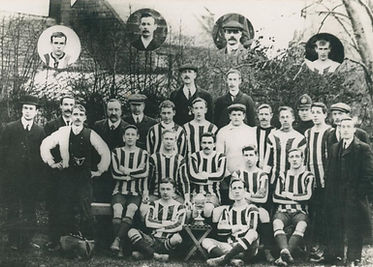
1908 PCFC - Runners up Sheffield Junior League

1910 PCFC - Sheffield Amateur Cup winners
PCFC original ground. Park Avenue and Park Lane 1936

Club Records 1906-2025


